Adresse
BEROTEC GmbH
Gewerbestr. 13
75057 Kürnbach
Deutschland
Öffnungszeiten
Mo, Mi und Fr:
08:00–12:00 und 13:00–17:00
Address
BEROTEC GmbH
Gewerbestr. 13
75057 Kürnbach
Deutschland
Opening hours
Mon, Wed and Fri:
08:00–12:00 and 13:00–17:00


On our journeys, we love to spend the night outside in the open countryside. This allows us to choose place and time freely, which on the one hand gives us flexibility, but in most cases simply rewards us with beautiful and unique overnight spots.
An old house ruin may not be spotless, but it can occasionally be an “interesting” place to stay for a night. Even better is an open field where we can roll out our sleeping bags under an old oak tree. Listening to the wind as it moves through the treetops. In the morning we’re woken by the warming sunbeams blinking through the meadow grass.


Even when a long ride in the rain has shown us the dark side of motorcycling, moisture and cold have soaked through every single layer, it doesn’t stop us from looking for a shelter outdoors. Many times we’ve been completely drenched, riding in the dark, and still managed to find a small hut in the woods where we could warm body and soul by a crackling campfire.
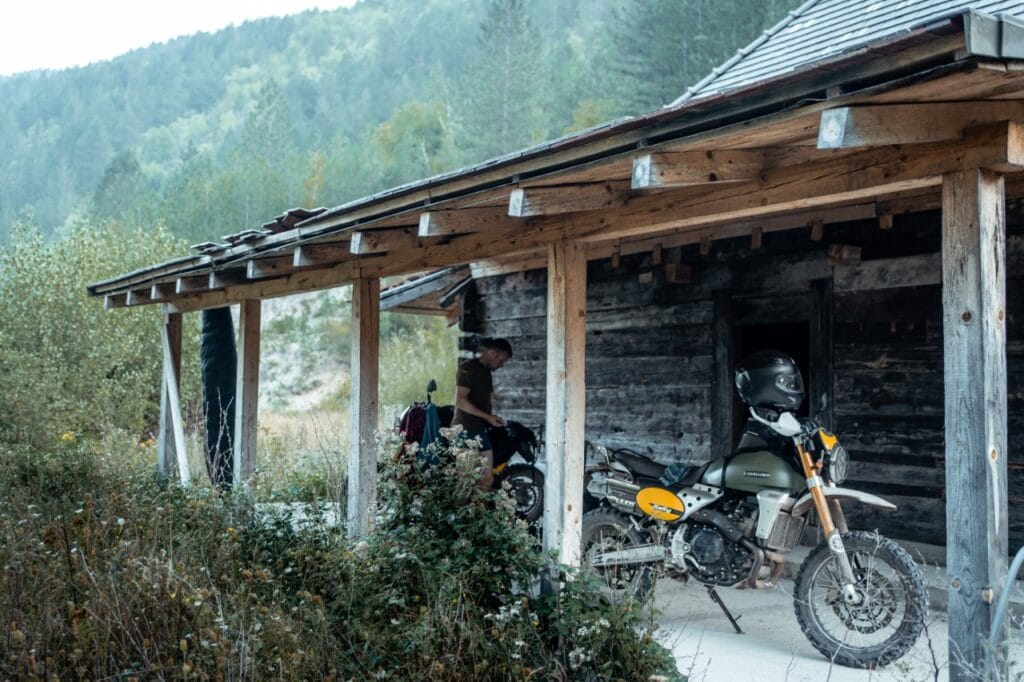

The most beautiful kind of bivouac is usually found on a summit. A night at 4,500 meters in the Andes rewards you with an incomparable starry sky that makes you forget the shivering cold. If you don’t want to travel that far, you can try your luck on the Cime de la Bonette at almost 3,000 meters in the French Alps. A 360° panorama is waiting there to be admired and photographed.


Alongside the often very beautiful moments in terms of landscape and plant life, we also keep running into animals. Waking up in Peru one morning, we found a tarantula sitting on our luggage bag – but encounters like that are thankfully the exception. Wild boars are usually very curious fellows but so far have always kept a safe distance. In France, we were woken in the middle of a large meadow by a white horse peacefully grazing right next to our heads. More often, though, we’ve been greeted in the morning by the bleating of goats or sheep, who are generally peaceful companions. Quite the opposite of the annoying street dogs that can be found in every corner of the world and tend to appear in the middle of the night just to keep you from sleeping.


Such unwanted encounters are part of the deal if you want to see the world. Anyone heading to Canada should be prepared for encounters with bears, but will probably have fewer worries about being disturbed at night by hikers, busybodies, or landowners.
When it comes to bivouacking, the human factor is probably the hardest to predict. Still, we’ve had many wonderful encounters with people around the world: in France, after a completely soaked night in a shelter in the woods, we were surprised with croissants in the morning. A kind Frenchman drove to the next village especially to bring us “pain au chocolat” and sweeten our day.
Nevertheless, we try to choose our sleeping spot as unnoticed and as far away from groups of people as possible. We don’t want to annoy anyone, and we don’t want to be disturbed ourselves. Even though there are exceptions, our encounters with other people have almost always been friendly and interesting. By now, we’ve developed a pretty good instinct that usually rewards us with an excellent spot in our “thousand-star hotel” while also providing peace and seclusion.
If we do end up bumping into another human soul, the rule is: smile and wave! A smile is often returned, even if you don’t speak the language. It also helps if you haven’t just cut down two trees for your camp and scattered your empty cans in a wide radius around it. Leaving as few traces as possible goes without saying for us.
The simplest version of our bivouac is just a groundsheet on the floor. On top of that goes a sleeping mat (optional), sleeping bag – done. Our tent is the night sky itself:


If it’s not cold enough, there’s no wind, or we’re not at enough altitude, we often have to unpack the mosquito net to protect ourselves from bites and other annoyances. Just park one motorcycle on each side of the groundsheet, throw the net over – done. The net also helps to some degree against crawling critters at ground level. You can get a short impression on ► YouTube


If it’s already raining or moisture is likely during the night, we stretch a tarp over the motorcycles (if necessary simply over the mosquito net) and guy it out. That way you’re protected from dew or light rain from above, but still have an unobstructed view across the fields. Admittedly: you won’t get through hours of heavy rain under it without getting wet.
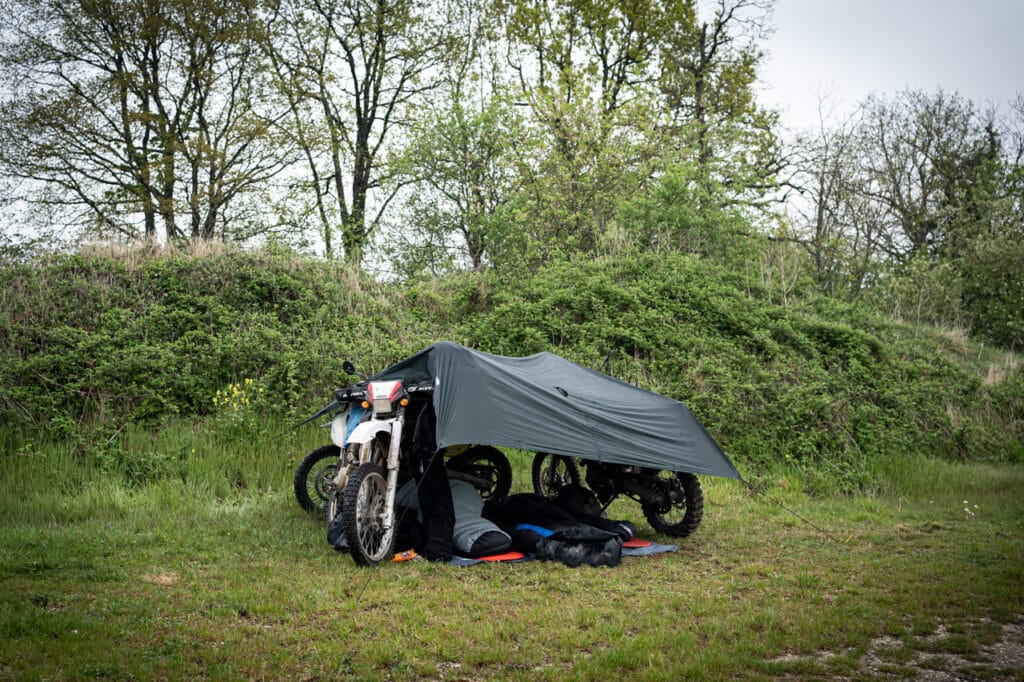
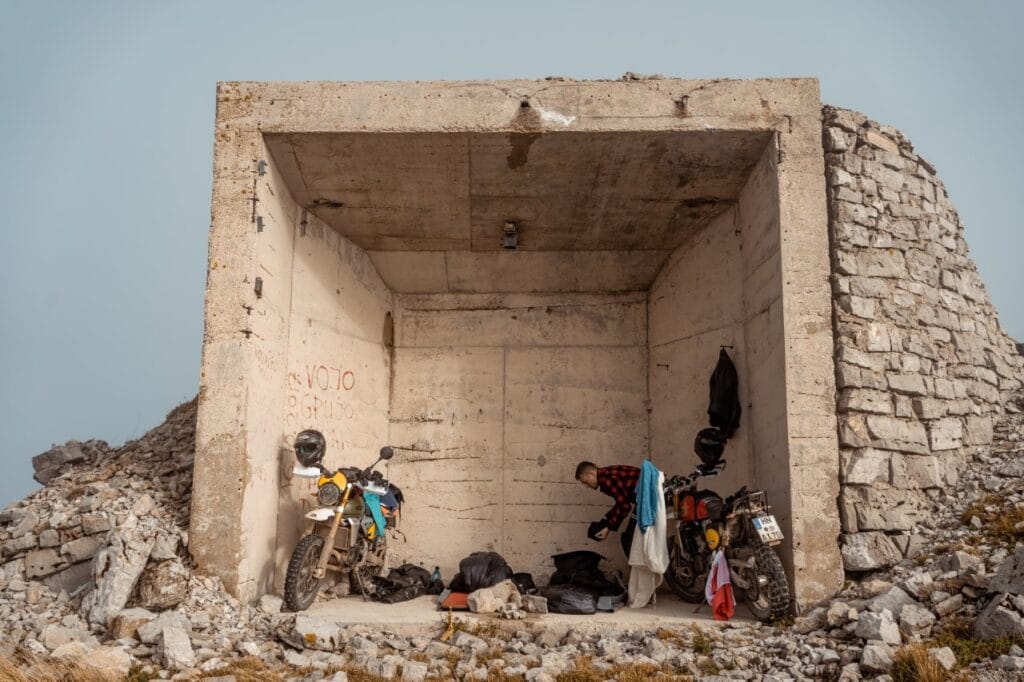
With this setup, we’ve found the ideal way of travelling for us. We don’t need a bulky tent, and camp can be set up – and packed away again – within a few minutes. Of course, this also means there’s no private retreat, which can be very important, especially on multi-month trips in unfamiliar regions. And sleeping without a tent on a campsite just isn’t an option. We are exposed to the weather, nature, the country and its people without that (mainly psychological) protective layer of fabric. Much like motorcycling itself: an experience that often lies outside the comfort zone.
We’ve put together a packing list of our most important travel essentials here:

Here is our ultimate packing list